
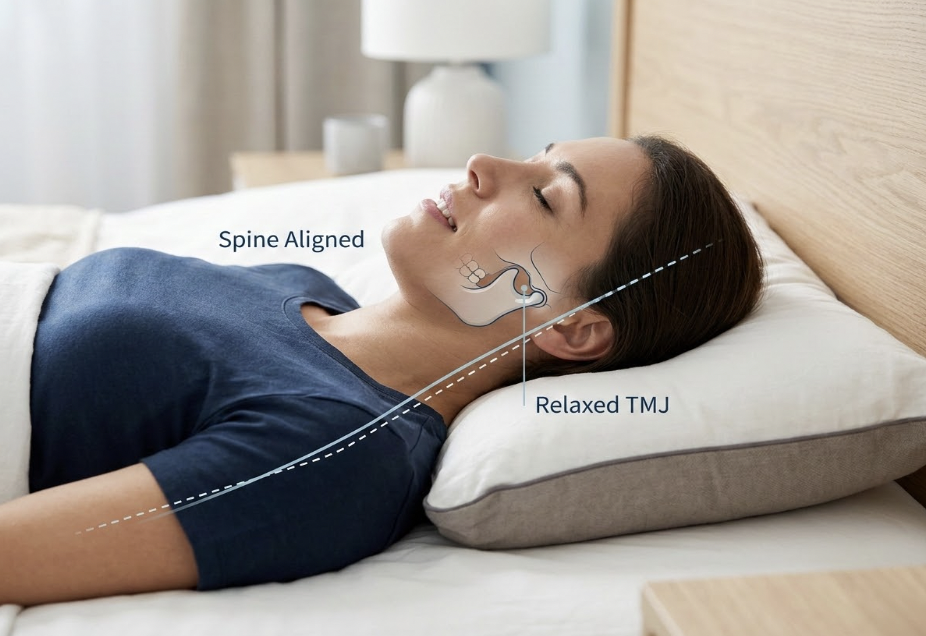

The best sleeping position for TMJ is on your back, with a supportive pillow that keeps your head and neck neutral. Side sleeping works if your head stays aligned. Stomach sleeping is the one to avoid.
If you wake up with a sore, tight jaw, your sleeping position might be part of the reason. You spend roughly a third of your life in bed, so even a small habit, like crushing one side of your face into a pillow, adds up over months. At Dental Line, we’re a dentist in Encino practice that treats jaw pain, and the sleep question comes up constantly. Here’s what actually helps, which positions to skip, and what to do when changing positions isn’t enough.
What Is the Best Sleeping Position for TMJ?
Sleeping on your back is the best position for most people with TMJ. When you lie face up, your head sits centered, your jaw can relax, and nothing presses against the joints in front of your ears. Gravity also pulls your lower jaw gently back and down instead of pushing it to one side.
Back sleeping isn’t perfect for everyone. If you snore or have sleep apnea, lying on your back can make breathing harder, and your doctor may suggest another position. Research on sleep position and jaw pain is still limited, so think of this as practical guidance based on how the joint works, not a guarantee. If back sleeping feels impossible, side sleeping with good alignment is the next best choice. For ongoing jaw discomfort, TMJ Treatment in Encino can help identify the underlying cause and provide appropriate treatment options.
Why Does TMJ Pain While Sleeping Happen?
TMJ pain while sleeping usually comes from clenching or grinding your teeth, combined with a position that puts your jaw under extra load. Most people clench at night without knowing it. Add a hand under your cheek or a twisted neck, and the joint gets pushed in a direction it doesn’t like for hours.
Stress, poor sleep, and an uneven bite make it worse. Sleep apnea is another common link, because your body tightens the jaw muscles during pauses in breathing. If you wake up with headaches, a stiff jaw, or worn teeth, tell us. Those are classic signs of nighttime clenching.
Which Sleeping Positions Make TMJ Worse?
Stomach sleeping is the worst for TMJ, followed by side sleeping with your face pressed into the pillow. Both positions twist your neck and load one jaw joint more than the other.
| Position | Effect on your jaw | Verdict |
|---|---|---|
| On your back | Head centered, jaw relaxed, even pressure on both joints | Best choice |
| On your side, head aligned | Fine if the pillow fills the gap between ear and shoulder | Acceptable |
| On your side, face in pillow | Presses on one joint and pushes the jaw sideways | Avoid |
| On your stomach | Twists the neck and forces the jaw to one side all night | Worst choice |
| Hand or fist under the chin or cheek | Adds direct pressure to the joint | Avoid |
If one side of your jaw is the sore one, sleep on the opposite side so you aren’t lying on it. And if you find yourself sliding onto your stomach after you fall asleep, try placing a pillow under your knees on your back, or hugging a body pillow when you’re on your side.
How Should You Set Up Your Pillow for TMJ?
Your pillow should keep your neck level with your spine so your jaw doesn’t have to pull to compensate. Too high pushes your chin toward your chest, and too flat lets your head tilt back. Both strain the muscles that run from your neck up to your jaw.
| Sleep position | Pillow guide | Extra tip |
|---|---|---|
| Back | Thin to medium pillow that supports the curve of the neck | Small pillow or rolled towel under the neck, pillow under the knees |
| Side | Firmer, taller pillow that fills the space from ear to shoulder | Keep the chin slightly tucked and the head in line with the spine |
| Switching positions | Medium pillow with a soft center | Alternate sides so one joint isn’t always carrying the load |
Skip the pillow stack that props your head up like you’re reading in bed. Also give a new pillow a couple of weeks before deciding whether it helps. Your muscles need time to adjust to a different position.
How Can You Train Yourself to Sleep on Your Back?
Changing a lifelong sleep habit takes a few weeks, and you won’t hold the new position all night at first. Start by falling asleep on your back, even if you drift to your side later. Place a pillow under your knees to ease your lower back, and tuck a pillow on each side of your body so rolling over feels less natural.
Some people sew a tennis ball into the back of a sleep shirt to discourage rolling onto their stomach. A body pillow does the same job more gently. Be patient with yourself. If you wake up on your side with good alignment, that’s still a win compared with a face-down night.
What Should You Do Before Bed to Relax Your Jaw?
A short wind-down routine can lower the clenching that drives TMJ pain while sleeping. These steps take about ten minutes:
- Hold a warm, damp cloth against the sore side of your jaw for five to ten minutes.
- Let your jaw hang loose, with your lips together and your teeth slightly apart.
- Gently massage the muscle in front of your ear in small circles.
- Take ten slow breaths, with a longer exhale than inhale, to settle your nervous system.
- Put your phone down and avoid stressful screens or arguments right before sleep.
None of this replaces treatment for a real joint problem, but it often takes the edge off. Track how your jaw feels in the morning for a couple of weeks and bring those notes to your visit. Details like which side hurts and when the pain peaks help us choose the right treatment faster.
What Else Helps With TMJ Pain While Sleeping?
A custom night guard is the most effective tool for nighttime clenching. It’s a smooth appliance made from a mold of your teeth that cushions them and lets the jaw muscles relax. Store-bought guards can feel bulky and sometimes worsen clenching, which is why we prefer a custom fit. You can learn about our approach on our TMJ treatment in Encino page.
Small habits help too. Cut caffeine after lunch, and avoid alcohol close to bedtime, since both can increase grinding. Try a warm, damp cloth on the sore side of your jaw for ten minutes before bed. Practice keeping your teeth slightly apart with your tongue resting on the roof of your mouth, even when you’re just sitting around. That “lips together, teeth apart” position carries over into sleep for many patients.
When Should You See a Dentist About TMJ Pain at Night?
See a dentist if jaw pain lasts more than a couple of weeks, if you wake with headaches most mornings, or if your jaw clicks, locks, or feels stuck. A new sleeping position can ease mild soreness, but it can’t fix a displaced disc or a bite problem.
If your pain also reaches your face, ears, or neck, our facial pain therapy evaluation looks at the whole picture. Get care quickly if the pain follows an injury, or comes with swelling and fever.
What Does TMJ Treatment in Encino Involve?
TMJ treatment in Encino at Dental Line starts with conservative, reversible care. Dr. Irena Starchenko completed hands-on Frontline TMJ and Facial Pain Therapy training and has more than 30 years in practice. We choose the gentlest option that fits your diagnosis, and most patients improve without surgery.
| Treatment | What it does | Best for |
|---|---|---|
| Custom night guard or occlusal splint | Cushions the teeth and reduces pressure on the joint | Grinding, clenching, morning jaw tightness |
| Bite adjustment | Corrects how the upper and lower teeth meet | Pain tied to an uneven bite |
| Jaw exercises and therapy guidance | Restores motion and loosens tight muscles | Stiffness and muscle-based pain |
| Pain management | Heat, cold, medication guidance, and habit changes | Flare-ups and day-to-day relief |
| Referral for advanced care | Coordinates care with an oral and maxillofacial specialist | Cases that don’t respond to conservative care |
To be clear, our training is continuing education, not an orofacial pain board certification. When a case needs a specialist, we tell you and coordinate the referral.
Frequently Asked Questions
What is the best sleeping position for TMJ pain?
Sleeping on your back with a supportive pillow is best for most people. It keeps your head centered and takes pressure off both jaw joints. If you prefer your side, keep your head in line with your spine.
Is it bad to sleep on your side with TMJ?
Not necessarily. Side sleeping is fine when your pillow keeps your neck level and your face isn’t pressed into it. Switch sides now and then, and avoid lying on the side that hurts.
Why does my jaw hurt more in the morning?
Morning jaw pain usually means you clench or grind at night. The muscles work for hours without rest, so they’re tight and sore when you wake. A custom night guard and stress control often help.
Can a pillow fix TMJ pain?
A good pillow can reduce strain from your neck and head position, but it won’t fix grinding or a bite problem. Think of it as one helpful piece, not the full treatment.
Should I wear a night guard if I sleep on my back?
If you clench or grind, yes. Your position affects pressure on the joint, while a night guard protects your teeth and calms the muscles. The two work best together.
Does sleep apnea affect TMJ pain?
Yes. Pauses in breathing can make your body clench the jaw to reopen the airway, which strains the joint. If you snore loudly or feel exhausted after a full night, ask your doctor about a sleep study.
Can I just stop clenching on my own?
It’s hard, since clenching happens while you’re asleep. Daytime awareness helps, but most people also need a night guard to protect their teeth and joints while they work on the habit.
Is TMJ treatment covered by dental insurance?
Many PPO dental plans cover at least part of TMJ treatment, especially oral appliances, though coverage varies by plan. Call our Encino office and we’ll help you check what applies to you.
Get Your Jaw Checked in Encino
Back sleeping with a well-fitted pillow is the best place to start for TMJ, and a few small habit changes can take the edge off in a week or two. If waking up sore is still your normal, don’t just keep rolling over. Dental Line is at 18024 Ventura Blvd in Encino. You can request an appointment online or call (747) 265-6179 to book a TMJ consultation with Dr. Starchenko.