
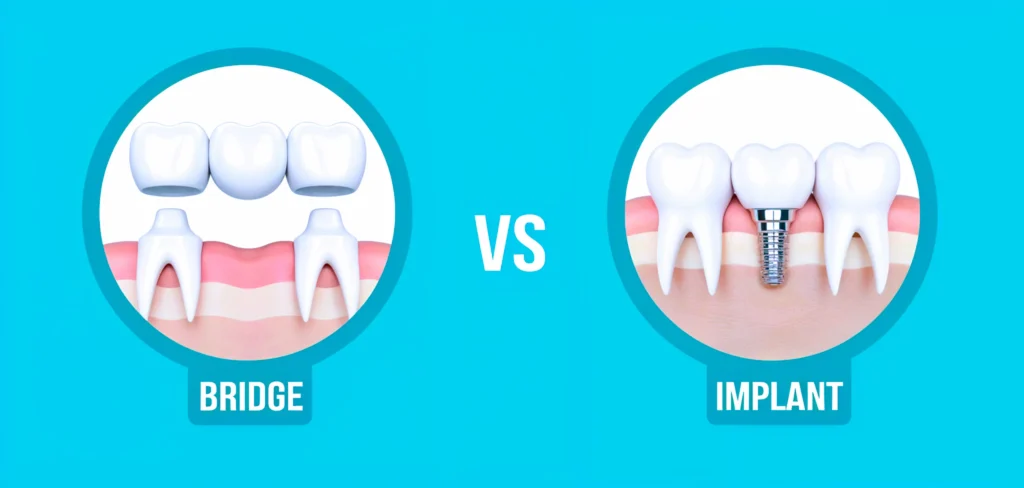

Dental bridges anchor a false tooth to neighboring teeth for support. Dental implants replace the root with a titanium post placed directly into your jawbone. With roughly 69 percent of adults ages 35-44 missing at least one tooth, your choice depends on budget, bone health, and how long you want the restoration to last.
Key Takeaways
- Tooth loss affects 69 percent of adults aged 35 to 44 in the United States today.
- Dental bridges and implants represent the two most popular modern solutions for replacing missing teeth.
- Many adults experience tooth loss as they age, making it important to address missing teeth early.
- Both treatment options require individual evaluation based on specific patient circumstances and dental health needs.
Why Does a Missing Tooth Need Replacing?
An empty socket rarely stays empty for long. Neighboring teeth drift into the open space over time, pulling your bite out of alignment and creating a domino effect across your smile. What starts as one missing tooth can quietly become crooked teeth, uneven wear, and jaw discomfort.
Tooth loss also happens more often than most people assume. An estimated share of adults between ages 35. 44 have lost at least one adult tooth, making this a shared concern rather than a rare exception. If you’re facing a gap right now, you’re far from alone, and waiting to address it rarely makes the situation simpler.
What happens if you don’t replace a missing tooth?
Left untreated, the gap invites surrounding teeth to shift and tip inward. That movement changes how your upper and lower teeth meet, straining your jaw joint and making chewing less efficient. Alignment problems that start small tend to compound with each passing year.
Where can you find restorative treatment in Encino?
Dental Line, based in Encino, California, offers restorative treatment for patients considering their options for missing teeth. Whether you’re comparing a dental bridge vs implant or exploring other paths to a complete smile, working with an experienced restorative dentist Encino patients trust helps you protect your bite before minor gaps turn into bigger structural problems.
How Do Bridges and Implants Actually Work?
Bridges and dental implants restore missing teeth through two fundamentally different methods: one anchors to neighboring teeth, while the other replaces the root itself. Understanding this distinction matters more than you might think. It affects how long your replacement lasts and how much of your natural tooth structure gets involved.
A dental bridge vs implant decision starts with how each device attaches. A bridge relies on crowns placed over the two teeth flanking the gap. Dentists call these supporting teeth abutment teeth. The crowns hold a false tooth suspended between them, filling the space without touching your jawbone at all.
An implant works from the ground up, literally. Surgeons place a titanium post directly into your jawbone, where it functions as an artificial tooth root. Titanium fuses with bone over time, giving the replacement a stable foundation that a bridge simply doesn’t have.
Does a bridge require healthy teeth on both sides?
Yes. Bridges depend on the abutment teeth being strong enough to support crowns and bear extra chewing force. If those neighboring teeth are compromised, your dentist may recommend an implant instead.
Dental Line provides both pathways as part of a broader set of restorative dentist Encino services, including crowns, dentures, root canals, and inlays or onlays. Dr. Irena Starchenko, DDS, brings more than 30 years of clinical experience to helping patients weigh these missing tooth options Encino against their oral health, budget, and long-term goals.
Consider the core mechanics side by side:
| Feature | Dental Bridge | Dental Implant |
|---|---|---|
| Anchor Point | Adjacent teeth (abutments) | Jawbone directly |
| Structure Involved | Crowns on two teeth | Single titanium post |
| Bone Contact | None | Fuses with bone |
Which Lasts Longer: Bridge or Implant?
Longevity separates these two restorations more than any other factor. A dental bridge vs implant comparison starts with structure: bridges rely on neighboring teeth for support, while implants stand independently in the jawbone. That difference in design shapes how each option holds up over years of chewing, brushing, and daily wear.
Bridges work well for patients missing multiple teeth in a row. A single bridge spans one gap or several adjacent gaps, replacing a whole section of missing teeth in one appliance. This flexibility makes bridges a practical choice when tooth loss extends beyond a single spot in the mouth.
Implants take a different approach. Dental Line offers implants as a long-term restorative treatment, designed to function effectively over many years. That upfront commitment often pays off through reduced need for replacement or adjustment down the road.
Do implants really outlast bridges?
Implant design integrates with the jawbone itself, giving the restoration a stability that bridges, dependent on surrounding teeth, cannot fully replicate. Bridges typically require replacement or repair sooner, especially if supporting teeth weaken over time.
What if the cost gap worries you?
Cost differences between bridges and implants concern many patients exploring missing tooth options Encino residents rely on. Dental Line, as a restorative dentist Encino patients trust, accepts most PPO insurance plans and offers flexible financing to help close that gap. Discussing your specific case with the practice helps clarify which option aligns with your needs and long-term goals.
Is Implant Surgery Right for You?
Implant surgery suits patients who want a permanent, bone-anchored replacement rather than a removable or tooth-supported solution. Titanium posts get placed directly into the jawbone with screws, then support a crown or bridge once healing completes. This surgical foundation is the core difference in the dental bridge vs implant decision. Bridges rely on neighboring teeth, while implants rely on bone.
Not every patient wants a surgical procedure, and that’s a fair concern. Bone density, healing time, and comfort with a dental procedure all factor into whether implants make sense for you. A restorative dentist Encino patients trust will evaluate your jaw structure before recommending a path forward.
How does a dentist know where to place the implant?
Precise planning starts before any drilling happens. Dental Line uses CBCT 3D scans alongside digital X-rays to map your jawbone in detail, reducing guesswork and surgical uncertainty. This imaging shows bone density, nerve position, and sinus location so the implant sits exactly where it should.
What if I’m nervous about surgery?
Nerves around implant surgery are common, and you don’t have to move forward blind. Sedation options are available for patients who want a calmer experience. Your dentist can also walk you through visual treatment explanations so you understand each step before committing.
Consider these factors when weighing your missing tooth options Encino:
- Bone volume available to anchor the implant
- Healing timeline versus a same-visit bridge preparation
- Comfort level with a surgical procedure
- Long-term maintenance expectations
Ask direct questions at your consultation. Understanding the process removes much of the uncertainty that keeps patients from moving forward.
How Can a Restorative Dentist in Encino Help?
A restorative dentist in Encino evaluates your bite, bone health, and budget before recommending a tooth-replacement path. Guidance from an experienced clinician turns a confusing decision into a manageable one. Dental Line sits on Ventura Blvd in Encino, with free parking available for patients weighing a bridge against an implant. That convenience matters when consultations, imaging, and follow-up visits stack up over several weeks.
Scheduling flexibility also shapes the experience. The Encino office stays open six days a week, Sunday through Friday, so appointments fit around work and family obligations. Patients researching missing tooth options in Encino rarely have unlimited free time. A six-day schedule reduces the wait between consultation and treatment.
What makes treatment feel less rushed?
Team size plays a bigger role than most patients expect. Dental Line operates with a small staff of six employees, which supports closer attention during exams and planning sessions. A smaller team means your questions about a dental bridge vs implant decision get answered thoroughly, not squeezed into a five-minute slot.
Can you start treatment the same day you decide?
Yes, in many cases. Same-day treatment availability lets you move forward once you. Your dentist settle on a bridge or an implant, cutting down the gap between decision and procedure. Additional comfort measures support that process:
- Sedation options for patients anxious about extended appointments
- Visual treatment explanations so you understand each step before it happens
- Same-day scheduling to avoid unnecessary delays once a plan is set
These factors together — location, hours, team size, and same-day capability. Remove much of the friction patients face when choosing a permanent tooth-replacement solution.
Conclusion
Choosing between a dental bridge and a dental implant comes down to your bone health, budget, and how long you want your results to last. Bridges offer a faster, non-surgical way to fill a gap by relying on the strength of neighboring teeth, while implants provide a standalone, bone-anchored solution built to hold up over many years. Neither option is universally “better” — the right choice depends on your individual bite, healing timeline, and comfort with a surgical procedure.
Whatever direction you’re leaning, getting a professional evaluation is the best next step. Dental Line’s Encino team can review your bone density, walk you through financing and insurance options, and help you settle on a missing tooth options Encino patients can feel confident about for years to come.