
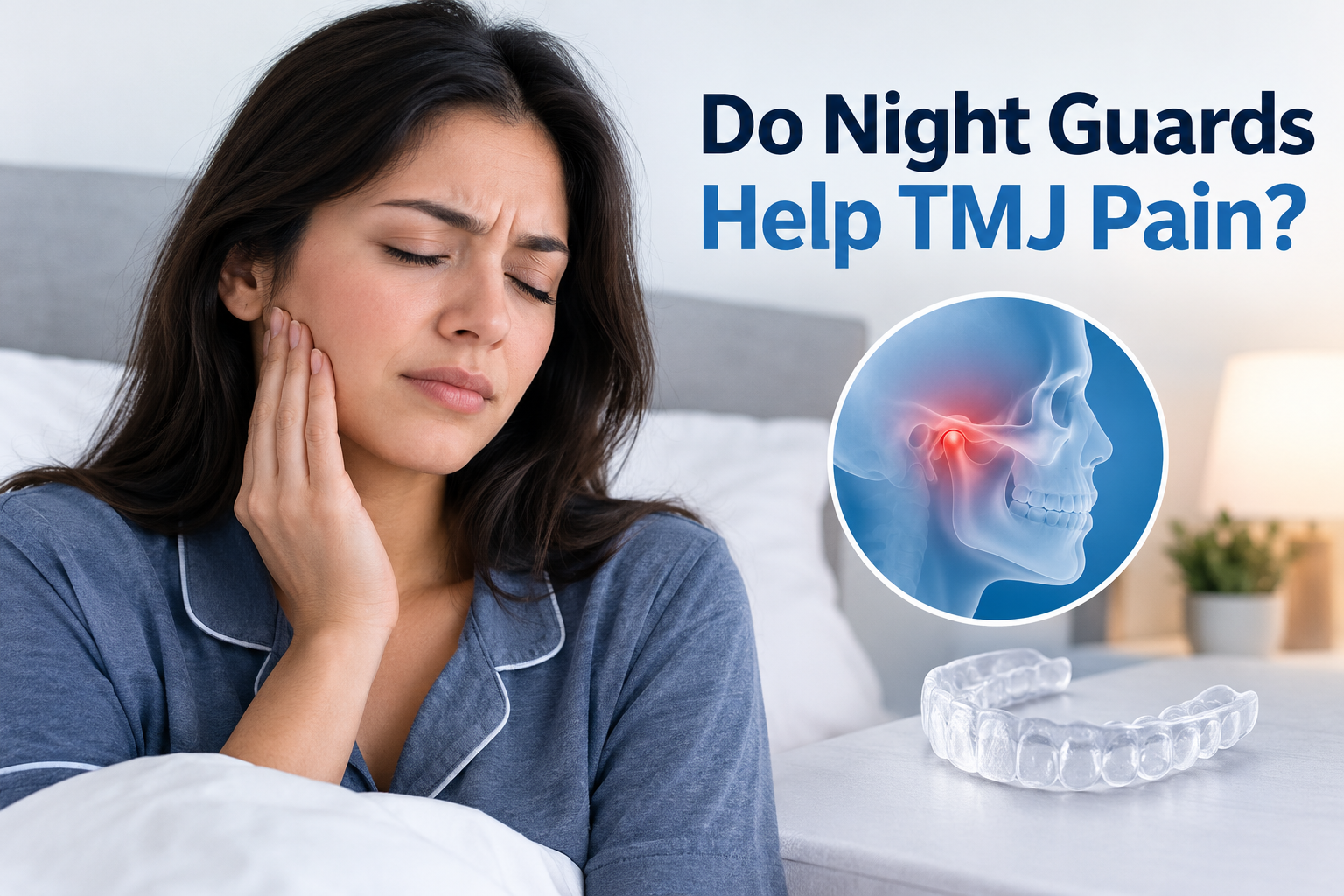

Yes, a night guard can help with TMJ pain when the pain comes from clenching or grinding. It does far less when the pain comes from a damaged disc or from arthritis inside the joint. The guard works by keeping your teeth from biting down at full force while you sleep, which takes pressure off the jaw muscles and the joint.
That is a narrower answer than most ads give. A night guard is a removable appliance, also called an occlusal splint, and it is one tool among several. Dental Line uses it as part of TMJ treatment in Encino, after an exam shows that clenching is actually driving the pain.
When does a night guard help TMJ pain, and when does it not?
A night guard helps when the muscles are the problem. It does not help much when the joint itself is damaged. Knowing which one you have is the whole point of the exam, because the same sore jaw can come from either.
| What is going on | Will a night guard help? |
|---|---|
| Nighttime clenching or grinding (bruxism) | Often, yes. It cuts the force on the teeth and muscles. |
| Morning jaw tightness and sore chewing muscles | Usually. Muscle pain responds best. |
| Worn, flattened, or cracked teeth from grinding | Yes. It protects the teeth from more damage. |
| Painful clicking from a displaced disc | Sometimes it eases the muscle part. It does not recapture the disc. |
| Arthritis inside the joint | Limited. The joint pain has a different cause. |
| Jaw locked open or closed | No. Locking needs an exam, not an appliance. |
The National Institute of Dental and Craniofacial Research says an oral appliance can ease pain tied to clenching or grinding. It also says the appliance should not permanently change your bite, and that treatments which do change the bite can make symptoms worse.
What does a night guard actually do to the jaw?
A night guard spreads the biting force across all of the teeth instead of letting a few teeth take the full load. That lowers the strain on the chewing muscles and gives the joint a quieter night.
It does three things and no more. It protects enamel from wear, it reduces muscle overload, and it keeps the teeth from gripping in the same tight position for hours. It does not move the jaw into a new position, and it does not repair a disc that has slipped out of place. Expecting it to do those jobs is how people end up wearing one for a year with no change in their pain.
Is a custom night guard better than a drugstore guard?
A custom night guard fits better and holds its shape, so it is the safer choice for TMJ pain. A drugstore guard is a reasonable short test, not a treatment.
Boil-and-bite and stock guards are soft, bulky, and molded by you. They rarely seat evenly, and an uneven guard can shift how the teeth meet or make clenching worse. A custom guard is made from an impression or digital scan of your teeth, built in hard acrylic, and adjusted in the office so every tooth lands on it at the same time. That even contact is what keeps it from changing your bite.
Which splint designs can make TMJ pain worse?
A flat stabilization splint is the standard design for clenching. Splints that hold the jaw forward or touch only the front teeth are a different device, and they carry real risks.
- Stabilization splint: covers a full arch with a flat biting surface. This is the type used for grinding and muscle pain.
- Repositioning splint: holds the jaw forward or back to try to recapture a disc. Wearing one for weeks can change how the teeth fit together.
- Anterior bite plane and NTI-style guards: only the front teeth touch. They can overload those front teeth and let the back teeth drift.
The evidence behind splints is weaker than the marketing suggests. The TMJ Association points to a 2020 National Academy of Medicine review that found the research on oral appliances to be poor in quality and mixed in its results. That is a reason to use the simplest design, for a defined stretch of time, and to recheck it.
How long should you wear a night guard?
Wear it at night, and have it checked within the first few weeks. A guard that is working shows it: less morning soreness, less headache on waking, and teeth that meet the same way they did before.
If nothing has changed after several weeks of consistent wear, the guard is probably not treating the real cause. Continuing it out of habit is not useful, and a guard that feels tight, rocks, or leaves a tooth sore should come out until it is adjusted. A well-made hard acrylic guard typically lasts several years, but heavy grinding shortens that, so it belongs on the list at every checkup.
How does Dental Line use night guards for TMJ in Encino?
Dr. Irena Starchenko examines the joint, the muscles, and the teeth before making anything. If clenching or grinding is the driver, she makes a custom stabilization guard and adjusts it at follow-up. If the exam points to a disc or joint problem instead, you leave with a referral rather than an appliance that will not help.
The guard is one part of care, not the whole plan. Jaw exercises, habit changes, and short-term anti-inflammatory medicine often do as much as the appliance. When grinding has already cracked or worn a tooth flat, that tooth may need its own repair, such as a dental crown, planned separately from the TMJ treatment.
Dr. Starchenko is a USC graduate with more than 30 years in practice, a member of the American Dental Association and the Academy of General Dentistry, and she completed Frontline TMJ and Facial Pain Therapy Level I training through the American Academy of Facial Esthetics in July 2026. The office is at 18024 Ventura Blvd, Encino, and she sees patients from Sherman Oaks, Tarzana, and Studio City. A dentist in Encino who checks the joint first will tell you if you need a guard at all.
Frequently asked questions
Can a night guard make TMJ worse?
It can, if it fits poorly or if it is a design that moves the jaw. A bulky drugstore guard or a splint that only touches the front teeth can increase clenching or change your bite. A flat guard adjusted by a dentist is unlikely to.
What is the difference between a night guard and an occlusal splint?
They are the same family of appliance. Night guard is the everyday name. Occlusal splint is the clinical one. The design matters more than the name.
Will a night guard stop me from clenching?
No. You will still clench. The guard reduces the force and spreads it out, so the muscles and the joint take less of it.
Can a night guard shift my teeth or change my bite?
A poorly fitted one can. A stabilization guard is adjusted so it does not. This is why it gets checked after you start wearing it, not just handed to you.
How much does a custom night guard cost, and does insurance cover it?
The cost depends on the material and the number of adjustment visits, and you get a written estimate before anything is made. Many PPO plans cover part of an appliance for grinding. Coverage varies, so bring your plan details to the visit.
How long does a custom night guard last?
A hard acrylic guard typically lasts several years. Heavy grinding wears through it faster, and it should be looked at during regular dental visits.
Find out if a night guard is the right fix
Bring the morning soreness, the clicking, or the worn teeth to an exam before you buy a guard. Dr. Starchenko will tell you whether clenching is the cause and whether an appliance belongs in the plan. Request an appointment or call (747) 265-6179.