
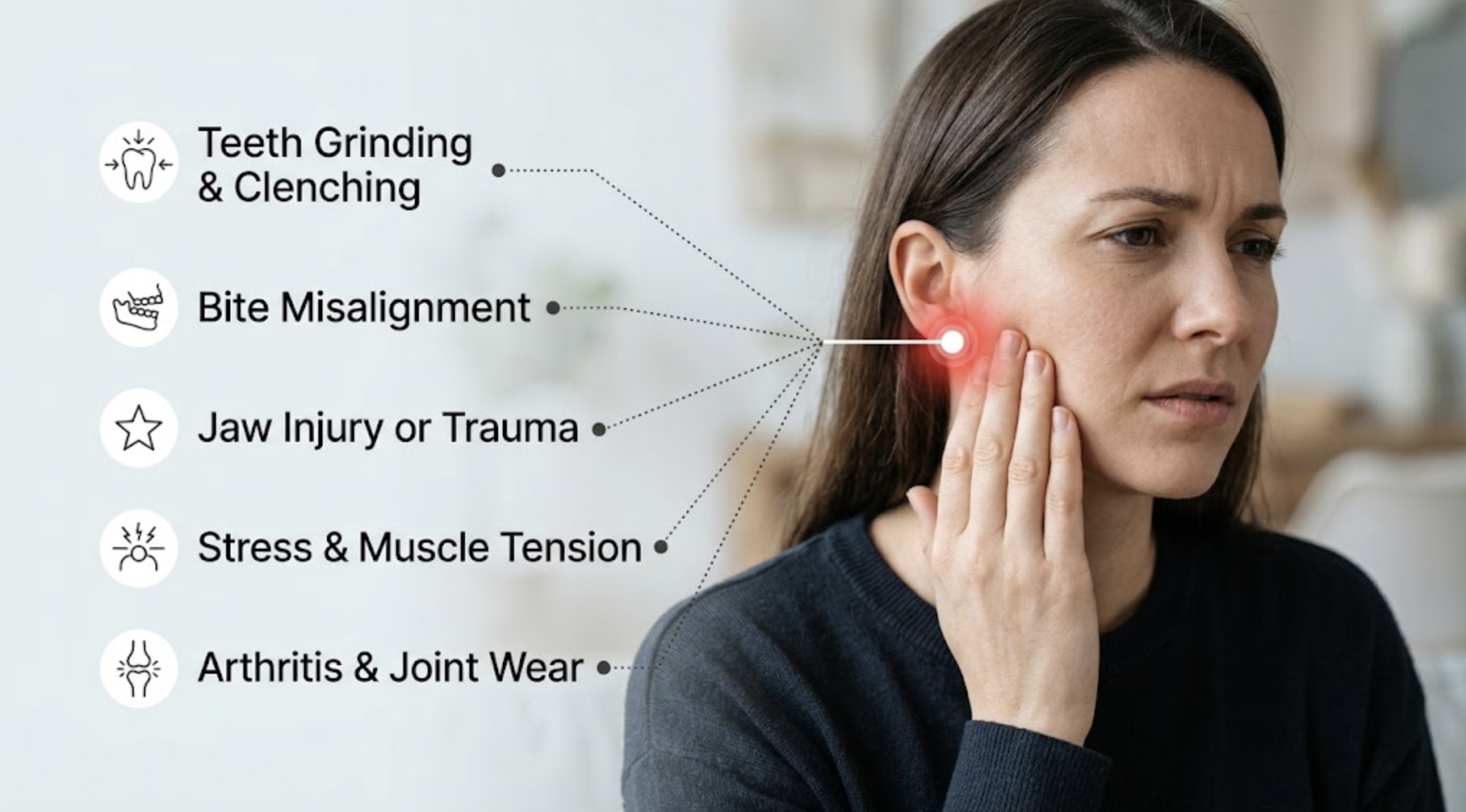

Jaw pain rarely has a single tidy explanation, and that’s frustrating when you just want to know what you did wrong. The truth is that TMJ disorder usually builds from several small stresses stacking up on one joint. At Dental Line, we’re a dentist in Encino practice, and finding the cause is the first thing we do, because treatment only works when it targets what’s actually driving your pain. Here are the main causes, the risk factors that make them more likely, and how we sort out which ones apply to you.
What Are the Main Causes of TMJ Disorder?
TMJ disorder happens when the temporomandibular joint, the hinge in front of each ear, or the muscles around it are overloaded or damaged. The five most common causes are teeth grinding and clenching, jaw injury, arthritis, a bite that doesn’t line up, and chronic stress that keeps the jaw muscles tight.
Researchers still can’t pin down one cause for every case, and in a fair number of patients the trigger never gets fully identified. That’s normal. Even then, treating the contributing factors usually brings relief.
| Cause | How it affects the joint | Clues you might notice |
| Teeth grinding and clenching | Overloads the disc and tires the jaw muscles | Morning jaw soreness, worn or flat teeth |
| Jaw injury or trauma | Displaces the disc or damages the joint surface | Pain or clicking that began after a hit or accident |
| Arthritis | Wears down cartilage and inflames the joint | Stiffness, grinding sounds, swelling |
| Bite misalignment | Forces the jaw to shift every time you close | Uneven wear, teeth that don’t meet evenly |
| Chronic stress | Keeps jaw and neck muscles tense all day | Headaches, tight shoulders, clenching when focused |
| Disc displacement | The cushion slips out of position | Clicking, catching, or a jaw that locks |
How Do Teeth Grinding and Clenching Cause TMJ?
Grinding and clenching are the biggest single cause we see. Your jaw muscles are strong, and when they squeeze for hours, especially at night, the force lands on the joint and its disc. Most people have no idea they do it. A partner who hears grinding, or teeth that look flat and chipped, is often the first clue.
It usually starts with stress, but poor sleep, caffeine, alcohol, and sleep apnea all push it along. Over months or years, the constant load wears the disc and tires the muscles until pain starts. That’s why a custom night guard is often the first tool we reach for.
Can a Jaw Injury or Trauma Cause TMJ?
Yes. A blow to the chin, a sports collision, a fall, or whiplash from a car accident can knock the disc out of place or damage the joint surface. Sometimes pain shows up right away, and sometimes it creeps in weeks later.
Less obvious injuries count too. Keeping your mouth open for a long dental procedure, or a breathing tube during surgery, can strain the joint for a few days. If your symptoms began after an incident, tell us the date. It helps us work out what’s damaged.
Does Arthritis Cause TMJ Disorder?
Arthritis is a well-known cause of TMJ disorder, and it can hit the jaw joint like any other joint. Osteoarthritis wears down the cartilage over time, while rheumatoid arthritis inflames the joint lining and can affect both sides at once. Both can cause stiffness, grinding sounds, and pain that worsens with chewing.
Arthritis-related TMJ is more likely to need ongoing management than a muscle-based case, and it often shows up in adults over 40. If you already have arthritis elsewhere, mention jaw symptoms to your doctor and your dentist.
How Does a Bad Bite Lead to TMJ Problems?
When your teeth don’t meet evenly, your jaw has to shift every time you close, and that tiny correction repeated thousands of times a day strains the joint. Missing teeth, crowding, worn fillings, and teeth that have drifted can all change how your bite fits together.
The link between bite and TMJ is debated in dentistry, and a perfect bite doesn’t guarantee a pain-free jaw. Still, when the exam shows an uneven bite along with joint symptoms, correcting it can take real pressure off the joint. We look at it case by case, never as an automatic fix.
What Role Do Stress and Daily Habits Play?
Stress tightens muscles, and your jaw is one of the first places it settles. People under pressure clench while they drive, work at a screen, or lie awake. Other habits add up too: chewing gum constantly, biting nails or pens, resting your chin on your hand, and cradling a phone between your ear and shoulder.
Posture matters more than people expect. A forward head position strains the neck muscles that tie into the jaw. None of these habits cause TMJ alone, but they keep an irritated joint from calming down.
What Are the TMJ Disorder Risk Factors?
The main TMJ disorder risk factors are being a woman between roughly 20 and 40, having arthritis or a connective tissue disorder, a history of jaw injury, high stress, and a habit of grinding or clenching. Having more than one risk factor raises the odds.
| Risk factor | Why it matters |
| Female sex, ages 20 to 40 | TMJ disorders are diagnosed more often in women, and hormones may play a role |
| Arthritis | Damages the cartilage and inflames the joint |
| Connective tissue disorders | Can make the joint loose or unstable |
| Previous jaw injury | May leave the disc or joint surface damaged |
| Teeth grinding or clenching | Creates constant overload on the joint |
| Chronic stress or anxiety | Keeps the jaw muscles tense |
| Sleep problems | Poor sleep and sleep apnea increase nighttime clenching |
| Family history | Joint and bite traits can run in families |
Having a risk factor doesn’t mean you’ll develop TMJ. Many people with several never get symptoms, and some with none do. Risk factors are a reason to pay attention, not to worry.
Can More Than One Cause Be Behind Your TMJ?
Most of the time, yes. The causes of TMJ disorder tend to overlap, and one often feeds another. Stress makes you clench, clenching wears the disc, and a worn disc makes the bite feel off, which makes you clench harder. Someone with arthritis who also grinds at night has two problems landing on the same joint.
That overlap is why a single fix, like a new pillow or a store-bought guard, so often falls short. We try to separate the pieces, treat the ones we can control first, and watch how the joint responds before adding anything.
How Do Dentists Find the Cause of Your TMJ Pain?
We find the cause through a physical exam, your history, and imaging when it’s needed. During your visit at Dental Line, we’ll watch how your jaw opens and closes, listen for clicking, press on the chewing muscles, and look at your teeth for wear. We’ll also ask about stress, sleep, injuries, and habits, because the answers often explain more than a scan does.
If something doesn’t add up, we may take X-rays or a 3D cone beam scan to look at the bone and the joint space. The goal is a plan built around your cause, not around the symptom you happen to be feeling today.
What Does TMJ Treatment in Encino Look Like?
TMJ treatment in Encino at Dental Line starts with conservative, reversible care matched to your cause. Dr. Irena Starchenko completed hands-on Frontline TMJ and Facial Pain Therapy training and has more than 30 years in practice. Most patients improve without surgery. You can read more on our TMJ treatment in Encino page.
| If your cause is | Treatment we may recommend |
| Grinding or clenching | Custom night guard or occlusal splint, plus stress and sleep habits |
| Bite misalignment | Bite adjustment to correct how the teeth meet |
| Muscle tension or limited opening | Jaw exercises and therapy guidance |
| Flare-ups and daily pain | Pain management with heat, cold, and medication guidance |
| Arthritis, injury, or severe joint damage | Referral to an oral and maxillofacial specialist |
To be clear, her training is continuing education, not an orofacial pain board certification. When a case needs a specialist, we tell you and coordinate the referral.
When Should You See a Dentist About TMJ?
See a dentist if jaw pain lasts more than a couple of weeks, if your jaw clicks, locks, or won’t open fully, or if you wake with headaches most mornings. Get care quickly if pain follows an injury or comes with swelling and fever.
If your pain reaches your face, ears, or neck, our facial pain therapy evaluation looks at the whole picture instead of treating each symptom on its own.
Frequently Asked Questions
What is the most common cause of TMJ disorder?
Teeth grinding and clenching are the most common causes. They overload the joint and tire the jaw muscles, often during sleep. Stress, poor sleep, and an uneven bite make them worse.
Can stress alone cause TMJ?
Stress rarely causes TMJ by itself, but it’s a major trigger. It makes you clench and tighten the jaw muscles, which strains the joint, especially if you already have another risk factor.
Can TMJ be caused by a bad bite?
It can contribute. An uneven bite makes the jaw shift every time you close. The link is debated, so we look at the bite alongside your muscles, habits, and joint, rather than assuming it’s the cause.
Is TMJ genetic?
There may be a family link. Joint structure, bite patterns, and conditions like arthritis can run in families. Habits and stress usually decide whether the tendency turns into symptoms.
Why do women get TMJ disorders more often?
TMJ disorders are diagnosed more often in women, especially between 20 and 40. Hormones may play a role, but researchers haven’t settled the reason. Higher rates of reporting pain could also contribute.
Can you have TMJ without pain?
Yes. Clicking or popping can occur without pain, and it often needs no treatment. Pain, locking, or limited opening is what calls for care.
Is TMJ treatment covered by dental insurance?
Many PPO dental plans cover at least part of TMJ treatment, especially oral appliances, though coverage varies by plan. Call our Encino office and we’ll help you check what applies to you.
Get Your Jaw Checked in Encino
TMJ disorder usually comes from a mix of grinding, injury, arthritis, bite problems, and stress, and the mix is different for everyone. Once we know yours, the plan gets much simpler. Dental Line is at 18024 Ventura Blvd in Encino. You can request an appointment online or call (747) 265-6179 to book a TMJ consultation with Dr. Starchenko.