
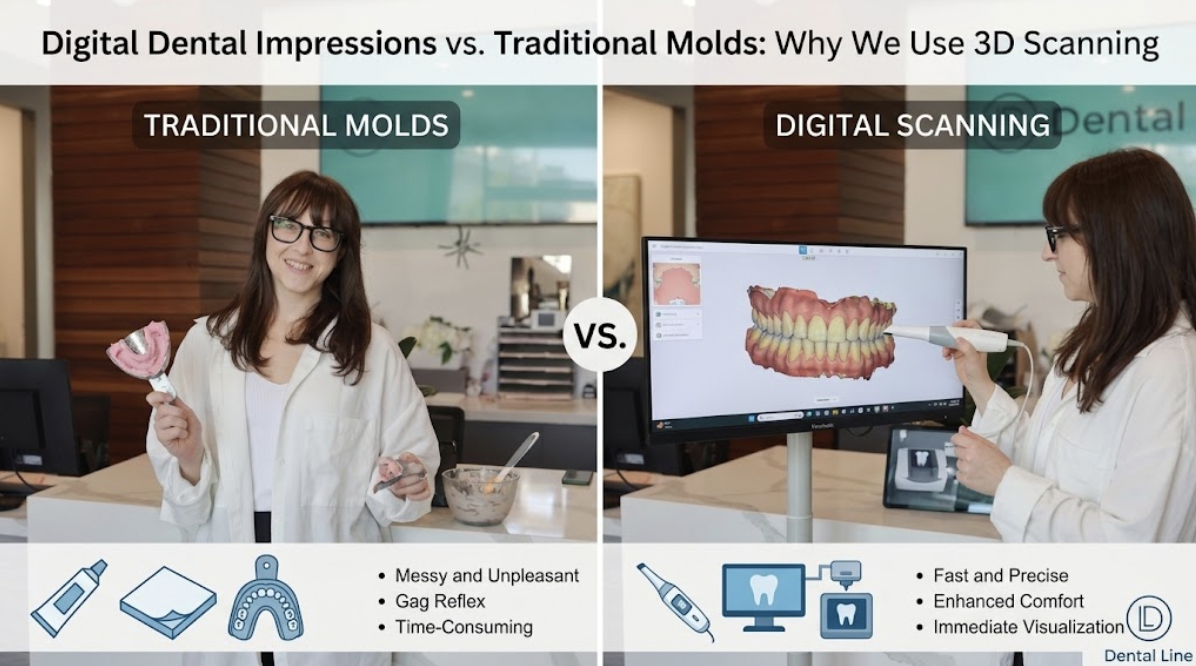

Digital dental impressions use a handheld 3D scanner to capture your teeth in minutes, with no trays or goopy putty required. Dental Line uses digital scanning for faster, more comfortable, more accurate results than traditional molds.
If your last dental impression involved biting into a tray of thick, slow-setting putty and holding still while it hardened, you already understand why patients ask about the alternative. A digital dental impression replaces that tray with a small handheld 3D scanner that photographs your teeth hundreds of times per second and builds an exact digital model in real time. Dental Line uses digital scanning for crowns, bridges, veneers, dentures, and clear aligner cases — the sections below explain exactly how the two methods differ, what the research says about accuracy, and what to expect at your appointment in Encino.
What Is the Difference Between Digital Impressions and Traditional Molds?
A traditional mold uses a putty material, usually PVS or alginate, loaded into a tray and held in your mouth for two to five minutes while it sets into a rubbery negative impression. A digital impression uses a wand-shaped 3D scanner that captures your teeth optically, with nothing placed in your mouth except the scanner tip itself.
How Traditional PVS or Alginate Molds Work
The dental team fills a metal or plastic tray with impression putty and presses it over your upper or lower teeth. You hold still while the material sets, then the tray is removed and either poured into a plaster model or shipped to a lab. If any area is under-captured, bubbled, or distorted on removal, the entire impression has to be retaken.
How 3D Intraoral Scanning Works
The digital intraoral scanner used at Dental Line captures your teeth as a live 3D image while Dr. Starchenko moves the wand along your bite in a guided pattern, building a complete digital model in minutes — see our equipment and technology page for the full list of in-office imaging tools.
You watch the 3D model build on a chairside screen in real time, and if one area needs a better capture, Dr. Starchenko simply re-scans that specific spot instead of restarting the entire impression.
Digital Impressions vs. Traditional Molds: Full Comparison
The table below compares the two methods across the factors patients ask about most.
| Factor | Traditional Mold (PVS/Alginate) | Digital 3D Scan (Dental Line) |
|---|---|---|
| Material in your mouth | Thick putty tray, held for 2–5 minutes | Small wand tip only, no putty |
| Gag reflex risk | Common, especially for back teeth or dentures | Minimal — low-profile wand, no tray |
| Capture time | 2–5 minutes of hold time per arch | Typically 3–5 minutes of scanning, no holding still |
| Retake if a spot is missed | Full impression redone | Just the missed area re-scanned |
| Model storage | Physical plaster model, can warp or break | Permanent digital file, cannot degrade |
| Lab turnaround | Physical shipping to an outside lab | Digital file sent instantly |
| Best for | Certain full-arch and multi-implant cases | Crowns, bridges, veneers, dentures, clear aligners |
Peer-reviewed research backs up what patients notice chairside: an umbrella review published on PubMed Central (NIH) found that intraoral scanners provide accuracy comparable to conventional impressions for short-span restorations such as single crowns and bridges, with consistently better patient comfort. The Journal of the American Dental Association likewise reports that digital scanning has become a standard chairside tool, while noting that some complex full-arch or multi-implant cases may still call for a traditional impression at your dentist’s discretion.
Why Gag Reflex and Comfort Matter
Patients with a sensitive gag reflex benefit the most from switching to digital scanning, because a bulky tray of setting putty pressed against the soft palate is the single biggest trigger for gagging during a traditional impression. The digital scanner wand is a fraction of the size of an impression tray and never needs to sit still while a material hardens.
- No putty taste or texture in the mouth
- No waiting for material to set while holding your bite closed
- Easier for children, patients with a strong gag reflex, and patients with latex or PVS sensitivities
- No risk of the tray triggering a cough or gag mid-impression
Is Digital Scanning as Accurate as Traditional Molds?
For single crowns, veneers, bridges, and clear aligner cases, digital scanning is comparably accurate to a well-taken traditional mold, and removes the human variables of material mixing, tray seating, and shipping distortion that can affect a physical impression.
The accuracy question depends on the case. For a single tooth or a short span of a few teeth, digital and traditional methods produce fitting restorations at a similar rate, and digital data has the added advantage of never warping or shrinking the way a plaster model can while a lab case is in transit. For select full-arch or multi-implant cases, some published research still favors a traditional impression for maximum precision, and Dr. Starchenko will recommend whichever method best fits your specific treatment plan rather than defaulting to one method for every case.
Who Benefits Most From Digital Impressions at Dental Line?
Patients getting a crown, bridge, veneer, denture, or clear aligner benefit most from a digital scan, because each of these restorations depends on an exact, distortion-free model of your teeth.
Crown and bridge patients: dental crowns and dental bridges both require a precise digital model so the restoration seats correctly on the first try, without a return visit for adjustments.
Denture patients: dentures fit against soft, moving tissue, and a digital scan captures that detail without the tray pressure that makes traditional denture impressions uncomfortable.
Veneer patients: porcelain veneers are planned from an exact digital model of your existing tooth shape and proportions before any enamel is prepared.
Clear aligner and Invisalign patients: clear aligner and Invisalign treatment plans are built entirely from a digital scan — there is no putty impression step in the aligner process at all.
Which Dental Line Treatments Start With a Digital Scan?
The table below shows what the same digital scan is used to plan across different treatments.
| Treatment | What the Digital Scan Is Used For |
|---|---|
| Dental crowns & bridges | Exact tooth-preparation shape sent to the lab for a precise-fit restoration |
| Dentures | Full arch and gum-tissue contour for a comfortable, stable fit |
| Veneers | Baseline tooth shape and proportions for smile design planning |
| Clear aligners / Invisalign | Full tooth-movement plan from your current bite to the final result |
| Retainers & night guards | Custom-fit model without a follow-up impression visit |
What to Expect During Your Digital Scan Appointment
A digital impression at Dental Line takes a few minutes, involves no injections or anesthesia, and produces a model you can see on screen before you leave the chair.
- Dr. Starchenko or a team member guides the scanner wand along your upper and/or lower teeth in a set pattern.
- The 3D model builds on a chairside monitor in real time, so you can see your own teeth being mapped.
- Any area that needs a clearer capture is simply re-scanned on the spot — no full redo.
- The finished digital file is reviewed with you and sent immediately to the lab or used to design your restoration or aligner plan.
Most patients combine a digital scan with a comprehensive dental exam, and first-time patients can review what a full visit involves on our your first visit page.
Why Choose Dental Line for Digital Impressions in Encino
Dr. Irena Starchenko, DDS brings 30+ years of clinical experience and a Doctor of Dental Surgery from the Herman Ostrow School of Dentistry at USC to every scan she takes and every restoration planned from it. Read more about her training and background on the Dr. Irena Starchenko page.
Dental Line is rated 4.9 out of 5 stars across 154 Google reviews, with patients consistently describing painless visits and clear, unhurried explanations of every recommended treatment.
Dr. Starchenko’s credentials and patient reviews are also independently verified on Healthgrades and US News Doctors, two of the most widely used third-party healthcare provider directories in the United States.
Frequently Asked Questions
Are digital dental impressions as accurate as traditional molds?
For single crowns, veneers, bridges, and clear aligner cases, yes — published research shows comparable accuracy, and digital files cannot warp or shrink the way a physical mold can during shipping.
Do digital scans trigger a gag reflex like traditional molds?
Rarely. The scanner wand is much smaller than an impression tray and does not sit in place while a material sets, which is the main reason traditional molds trigger gagging.
How long does a digital dental impression take?
A digital scan typically takes three to five minutes per arch, about the same total chair time as a traditional mold, but without the two-to-five-minute hold while putty sets.
Does insurance cover digital impressions?
Digital scanning is billed as part of the treatment it supports, such as a crown or aligner case, rather than as a separate charge. Check our insurance page for accepted PPO plans, or call to verify your specific benefits.
Can children get a digital dental scan instead of a mold?
Yes. Most children tolerate a digital scan better than a traditional mold, since there is no putty taste or texture and no need to hold still while material sets.
Do you ever still use traditional molds at Dental Line?
Occasionally, for select full-arch or multi-implant cases where a traditional impression may offer additional precision. Dr. Starchenko will tell you which method she recommends for your specific case.
Is a digital dental impression the same as the 3D dental scan used for implants?
No. A digital impression scans the visible surface of your teeth for restorations like crowns and aligners. A 3D dental scan (CBCT) is a different technology that images bone, nerves, and jaw structure for implant and TMJ planning.
Conclusion: Which Method Is Right for Your Treatment?
Digital dental impressions have replaced traditional putty molds for the large majority of restorations at Dental Line because they are faster, more comfortable, and, for single crowns, bridges, veneers, and clear aligner cases, comparably accurate to a well-taken conventional impression — without the gag reflex, the wait for material to set, or the risk of a plaster model warping in transit.
Traditional molds have not disappeared entirely — Dr. Starchenko still reaches for one in select full-arch or multi-implant cases where it offers an edge — but for most crowns, veneers, dentures, and clear aligner cases, a digital scan is the faster and more comfortable choice.
If you are due for a restoration or considering Invisalign, call (747) 265-6179 or request an appointment online, and Dr. Starchenko will confirm which impression method is right for your case.