
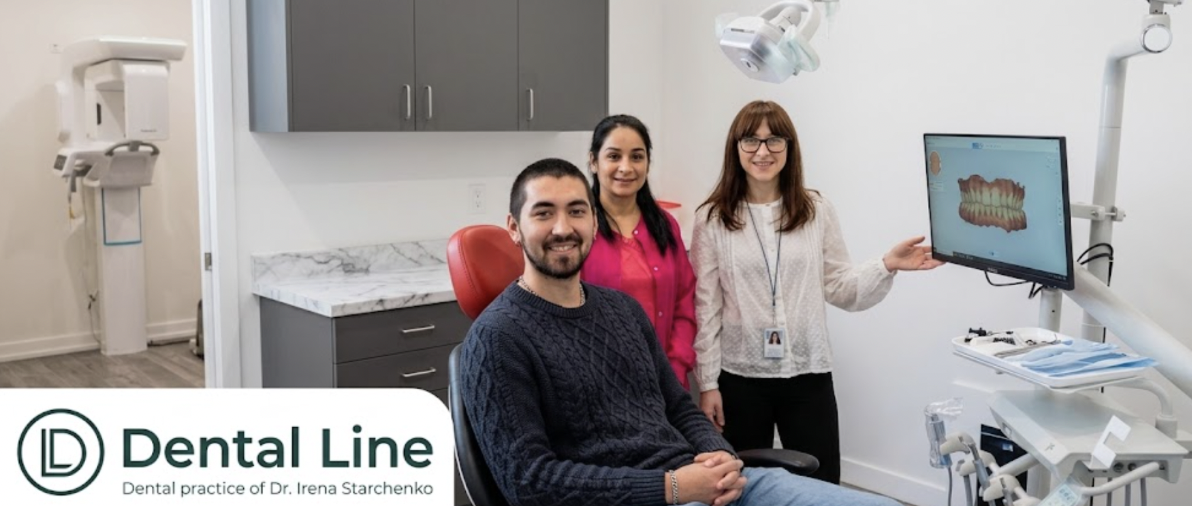

A 3D dental scan replaces the goopy putty tray with a small handheld wand that photographs your teeth — nothing sits in your mouth, nothing sets, and most patients feel nothing more than light pressure for a few minutes.
If your last dental impression involved biting into a tray of thick putty and holding still while it set, bracing for that same feeling is the biggest reason patients put off treatment. A 3D dental scan at Dental Line removes that step entirely. This walkthrough covers exactly what the experience feels like, minute by minute, from someone sitting in the chair — for the full technical comparison of digital scanning versus traditional molds, see our digital impressions guide.
What Does a 3D Dental Scan Actually Feel Like?
A 3D dental scan feels like a small camera moving along the outside and biting surfaces of your teeth — no tray, no putty taste, and nothing that stays in place while it hardens.
There is no gag-inducing bulk pressed against the back of your mouth, no chalky taste, and no waiting with your jaw held open while material sets. The wand is roughly the size of an electric toothbrush head.
Most patients describe the sensation as closer to having their teeth polished than to anything involving a tray — brief, light, and localized to wherever the wand is at that moment rather than a constant pressure across the whole mouth.
What You Hear and See
The scanner makes a faint humming or clicking sound as it captures images, quieter than the suction tool used during a cleaning, and there is no drilling sound at any point since nothing is being cut or shaped.
Most patients watch the screen beside the chair as their own 3D tooth model builds in real time, which shifts attention away from the sensation of the wand itself and onto the image forming on screen.
Before, During, and After: What Changes
Before the scan, you sit normally in the chair with nothing placed in your mouth yet. During the scan, you feel intermittent light contact and occasional air as the wand passes over each tooth, with brief pauses to reposition. After the scan, there is no aftertaste, no residue, and no lingering jaw fatigue the way a held-open bite from a mold impression can leave behind.
A Minute-by-Minute Walkthrough of Your Scan
- You sit back in the chair as you would for a cleaning — no reclining flat, no bite registration material handed to you.
- Dr. Starchenko or a team member starts the wand at your back teeth and glides it along the chewing surface, then the outer surface, then the inner surface of each tooth.
- You feel light contact and occasional air, similar to a routine cleaning, but nothing that fills your mouth or restricts your jaw.
- A 3D model builds on a screen next to you in real time, so you can watch your own teeth take shape instead of waiting for a result.
- If a section needs a clearer image, that specific spot is re-scanned for a few extra seconds — the whole process does not restart.
- The full scan is typically finished in three to five minutes per arch, and you can talk, swallow, and breathe normally throughout.
If You Feel Anxious Before Your Appointment
Telling the team in advance that you have had a difficult experience with molds in the past lets Dr. Starchenko pace the scan more slowly, pause between sections, or explain each step as it happens — adjustments that are not possible once a traditional impression tray is already set in your mouth.
Some patients also find it helpful to hold their phone or a stress object during the scan, or to keep their eyes on the chairside screen rather than closing them — since watching the model build in real time gives your attention somewhere to go besides the sensation itself.
Why Goopy Molds Trigger Gagging (and Scanning Does Not)
Traditional molds trigger gagging because a bulky tray of soft material is pressed against the back of the palate and held there while it sets — the exact combination of pressure, bulk, and duration that activates the gag reflex.
The gag reflex is a protective response to something perceived as blocking the airway, and a full impression tray checks every box that triggers it: it is large, it reaches toward the soft palate, and it cannot be removed or repositioned until the material has fully set, often 60 to 90 seconds that can feel much longer.
A scanning wand removes two of those three triggers: there is no bulk filling your mouth and nothing has to sit still while it hardens. For the full technical and accuracy comparison between the two methods, see our digital impressions vs. traditional molds guide.
Who Feels the Biggest Relief Switching to Digital Scanning
Patients with a strong gag reflex, young children, and anyone with a latex or PVS material sensitivity notice the biggest difference switching from molds to scanning.
- Patients who have avoided or delayed treatment specifically because of a bad past impression experience — the anticipation of a repeat bad experience is often worse than the impression itself, and removing the trigger removes the anticipation.
- Children, who often struggle to hold still for the two-to-five-minute mold-setting time — a moving target that increases the chance of a smudged, unusable impression requiring a retake.
- Patients with a sensitive gag reflex triggered by anything touching the soft palate — scanning the back molars is done in short passes rather than one sustained tray placement.
- Patients with a known sensitivity or allergy to PVS or latex impression materials — scanning involves no impression material at all, removing the allergy risk entirely.
What Patients Say About the Scan Experience
Dental Line is rated 4.9 out of 5 stars across 154 Google reviews, with patients specifically describing the scanning experience as fast and easy compared to past impressions at other offices. Read more on our testimonials page.
The comments that come up most often are not about the technology itself, but about what it removed: no gagging, no bad taste, and no dreading the appointment beforehand the way some patients describe past experiences with impressions elsewhere.
What Happens After Your Scan
Once your scan is complete, the digital model is used immediately to plan your treatment — there is no separate step of pouring a plaster model or shipping an impression to a lab.
Because the file is digital from the start, there is also nothing that can warp, shrink, or get damaged in transit the way a physical impression or plaster model can, which is one more step of uncertainty removed from your treatment timeline.
The same scan is used to plan crowns, bridges, dentures, veneers, and clear aligner or Invisalign cases — see how it builds an Invisalign smile preview before you commit to treatment.
Why Patients Choose Dental Line for a Comfortable Scan
Dr. Irena Starchenko, DDS brings 30+ years of clinical experience and a Doctor of Dental Surgery from the Herman Ostrow School of Dentistry at USC to every scan she performs. Read more on the Dr. Irena Starchenko page.
That experience shapes how the scan itself is paced — knowing which areas typically need a second look, which patients need a slower pass near the back teeth, and how to keep the whole process moving without rushing it.
Her credentials and patient reviews are independently verified on Healthgrades and US News Doctors, two of the most widely used third-party healthcare provider directories in the United States.
Frequently Asked Questions
Does a 3D dental scan taste like anything?
No. Unlike putty impression material, the scanning wand has no taste or texture — it simply photographs your teeth.
Can I breathe and swallow normally during the scan?
Yes. Nothing blocks your airway or fills your mouth, so you can breathe and swallow throughout the scan just as you would during a routine cleaning.
What if I have a strong gag reflex?
Most patients with a strong gag reflex find scanning far more tolerable than a traditional mold, since there is no bulky tray pressed against the back of the palate. Let the team know in advance and they can pace the scan accordingly.
Is it really completely painless?
For the large majority of patients, yes — the scan involves light contact only, no needles, no anesthesia, and no pressure that causes discomfort.
How accurate is a digital scan compared to a traditional mold?
For crowns, bridges, veneers, and aligner cases, digital scanning is comparably accurate to a well-taken traditional impression. See our full accuracy comparison for the research and data behind that.
Can children get a digital scan instead of a mold?
Yes, and most children tolerate it better than a traditional mold since there is no taste, texture, or requirement to hold still for several minutes.
What if I move or flinch during the scan?
Minor movement is not a problem — the software tracks and stitches the images together, and any section affected by movement can simply be re-scanned for a few extra seconds rather than restarting the whole process.
Do I need to do anything to prepare for a digital scan?
No special preparation is needed. Brushing beforehand is helpful but not required, and there is no fasting, medication adjustment, or other prerequisite the way there can be for some medical imaging.
Conclusion: A Scan, Not a Mold
The goopy tray, the chalky taste, and the wait for material to set are no longer part of getting a crown, denture, veneer, or Invisalign plan at Dental Line — a 3D scan replaces all of it with a few minutes of light, painless contact.
If a past impression experience is the reason you have put off a visit, that specific reason no longer applies here — the tray, the taste, and the wait are simply not part of how Dental Line captures your teeth anymore.
The scan itself takes less time to complete than it will likely take you to read this page, and there is no recovery period or lingering aftereffect once it is done.
That is the whole point of the experience described above: not a new piece of technology to learn about, but one specific, dreaded step removed from a visit you were already going to need.
For the technical side of how digital scanning compares to traditional molds, read our full digital impressions guide.
Call (747) 265-6179 or request an appointment online to experience it yourself.
Experience a Painless Scan at Dental Line
Dental Line is located at 18024 Ventura Blvd, Encino, CA 91316, open Sunday through Friday from 10 AM to 6 PM. Call (747) 265-6179 or request an appointment online.