
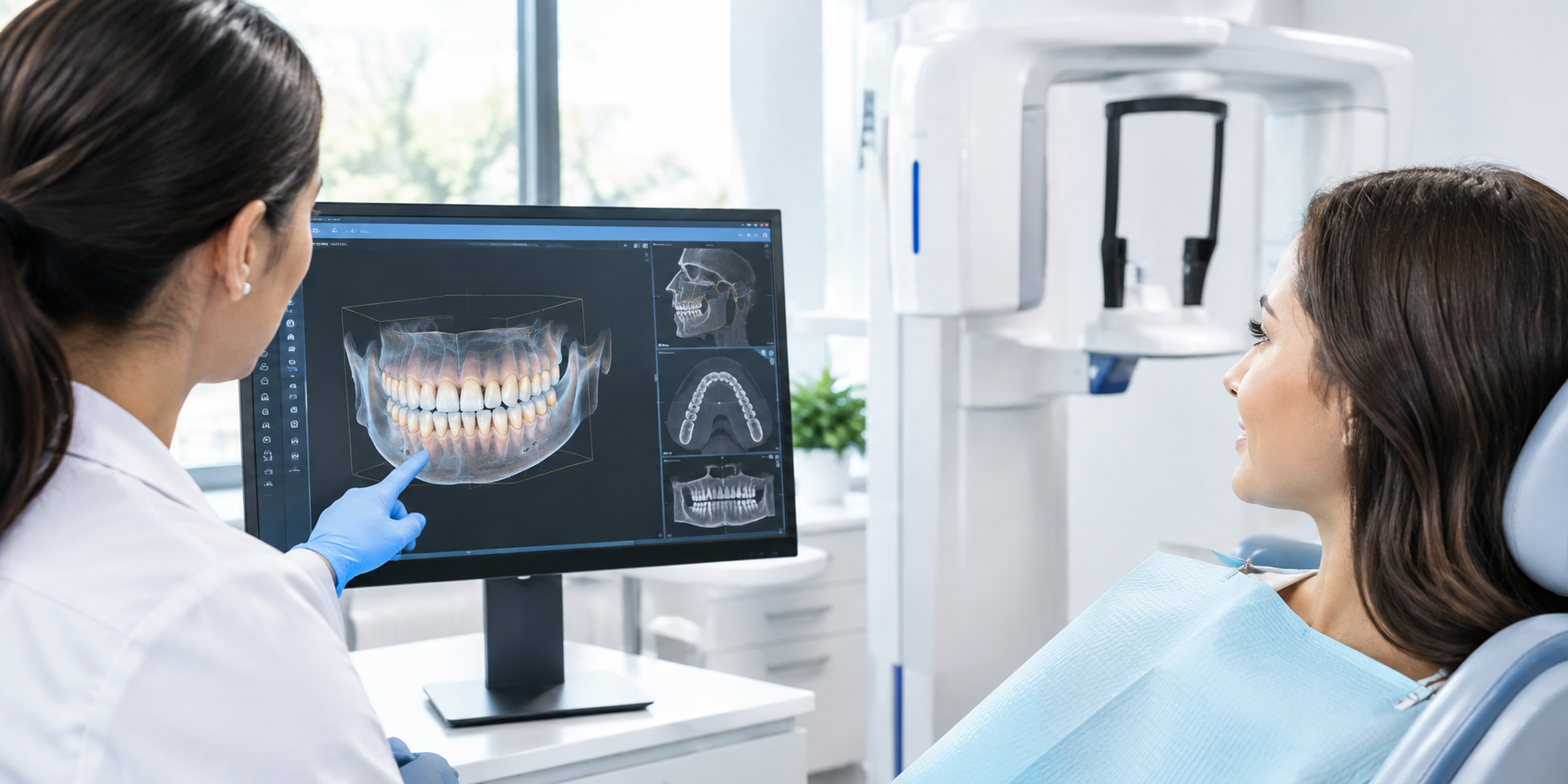

Yes, 3D dental scans (CBCT) are safe. A single scan at Dental Line uses a low-dose, small-field protocol delivering about the radiation of three to seven days of natural background exposure, far below a medical CT scan.
Medically reviewed by Dr. Irena Starchenko, DDS — Doctor of Dental Surgery, Herman Ostrow School of Dentistry at USC (2020), Master of Orthodontics (1999), 30+ years of clinical practice, and member of the American Dental Association (ADA) and Academy of General Dentistry (AGD).
If you have been told you need a 3D dental scan, also called a Cone Beam Computed Tomography (CBCT) scan, before a dental implant, root canal, or orthodontic treatment, the radiation question is the right one to ask. Dental Line answers it directly: CBCT imaging has been used safely in dental offices for more than two decades, is cleared by the U.S. Food and Drug Administration (FDA), and follows the same ALARA principle — As Low As Reasonably Achievable — that governs every other form of medical and dental radiography. The sections below break down the actual radiation numbers, who should take extra precautions, how a 3D dental scan compares to a traditional X-ray and a hospital CT scan, and what to expect at your appointment at our Ventura Blvd office in Encino.
Is a 3D Dental Scan (CBCT) Safe?
A 3D dental scan is safe for the large majority of patients, including most children and pregnant patients when the scan is clinically necessary and precautions are followed. Dental Line only recommends a CBCT scan when a 2D X-ray cannot provide enough diagnostic detail — never as a routine or default step.
Radiation Dose Comparison
The table below shows how a 3D dental scan compares to other common imaging you may already be familiar with, using effective dose ranges published in dental radiology dosimetry literature.
| Imaging Type | Approx. Effective Dose | Equivalent Background Radiation |
|---|---|---|
| Digital bitewing X-ray (2 films) | ~4–5 µSv | About half a day |
| Digital panoramic X-ray | ~9–24 µSv | About 1–3 days |
| Full-mouth digital X-ray series | ~35 µSv | About 4 days |
| Small field-of-view dental CBCT | ~20–100 µSv | About 3–12 days |
| Large field-of-view CBCT | ~200–900 µSv | About 3 weeks–3 months |
| Medical head CT scan | ~1,500–2,000 µSv | About 6–8 months |
| Average U.S. annual background radiation | ~3,000 µSv/year | 1 year (baseline) |
Dental Line uses a small field-of-view, low-dose CBCT protocol, which sits at the lower end of the dental CBCT range shown above and is a small fraction of a medical CT scan. Every scan is limited to the smallest field of view and lowest dose setting that still answers the clinical question — the ALARA principle in practice.
The ALARA Principle in Dental Imaging
ALARA — As Low As Reasonably Achievable — means Dr. Starchenko orders a scan only when the diagnostic benefit outweighs the radiation dose, and always uses the lowest dose settings that still produce a usable image. Digital CBCT sensors already require significantly less radiation than older film-based X-ray systems, and Dental Line applies size- and age-appropriate exposure settings for every patient.
Who Should Take Extra Precautions
Three patient groups warrant extra discussion with Dr. Starchenko before a scan:
- Pregnant patients: A CBCT scan is deferred unless there is a dental emergency, in which case a lead apron and thyroid collar are used and the field of view is minimized.
- Young children: Pediatric CBCT protocols use a reduced dose and a smaller field of view, and are reserved for cases such as impacted teeth or orthodontic planning where a 2D X-ray is not sufficient.
- Patients needing frequent imaging: The ADA and FDA jointly recommend that dental imaging be ordered based on individual clinical need and history, not on a fixed annual schedule — so scan frequency is a conversation with your dentist, not a default routine.
What Is a 3D Dental Scan (CBCT)?
A 3D dental scan, or CBCT scan, is an in-office imaging technology that rotates a cone-shaped X-ray beam around your head to build a three-dimensional model of your teeth, jawbone, nerve pathways, and sinuses in a single pass. Unlike a flat 2D X-ray, a CBCT scan lets Dr. Starchenko view your anatomy from any angle and measure exact bone depth, width, and density.
3D CBCT Scan vs. Traditional X-Ray vs. Medical CT Scan
The comparison below shows why Dr. Starchenko chooses a specific imaging type for each clinical situation.
| Feature | 2D Dental X-Ray | 3D CBCT Scan (Dental Line) | Medical CT Scan |
|---|---|---|---|
| Image type | Flat, single-plane | Full 3D volumetric model | Full 3D, whole-body grade detail |
| Typical radiation dose | Lowest per image | Low, small-field protocol | Highest of the three |
| Scan time | A few seconds | Under 20 seconds | 5–10 minutes |
| Best for | Cavities, routine bone checks | Implants, impacted teeth, TMJ, complex root canals | Trauma, tumors, whole-head medical diagnosis |
| Where performed | Dental office | Dental office (Dental Line, Encino) | Hospital or imaging center |
The key takeaway for patients: a 3D dental scan is not the same procedure as a hospital CT scan. It uses a fraction of the radiation, is performed chairside in minutes, and is purpose-built for dental and jaw anatomy rather than whole-body diagnostics.
Who Benefits Most From a 3D Dental Scan in Encino?
Patients planning dental implants, complex root canals, TMJ treatment, or orthodontic correction of impacted teeth benefit most from a CBCT scan, because these procedures require exact 3D measurements a 2D X-ray cannot provide.
Dental implant planning: Dental implants require precise measurement of bone height, width, and density, plus the exact location of the nerve canal and sinus floor, to place the implant safely and avoid nerve injury.
Complex root canal treatment: root canal treatment on molars with curved or extra canals is more predictable when Dr. Starchenko can see the full 3D canal anatomy before starting.
TMJ and facial pain diagnosis: TMJ therapy relies on a clear 3D view of the jaw joint to identify structural causes of clicking, locking, or facial pain.
Impacted teeth and orthodontics: braces treatment for impacted or crowded teeth is planned more accurately with a 3D view of root position and available bone.
Invisalign and clear aligner cases: Invisalign and other clear aligner treatment plans use 3D scan data to model tooth movement before your first tray is made.
What Happens During Your 3D Dental Scan Appointment?
A 3D dental scan at Dental Line takes less than 20 seconds and requires no injections, sedation, or recovery time. Here is what to expect, step by step:
- You stand or sit in the open CBCT unit — it is not an enclosed tube, so there is no risk of claustrophobia.
- A protective apron is placed if clinically indicated, and you are asked to stay still for the rotation.
- The scanner arm rotates once around your head, capturing the full 3D dataset in under 20 seconds.
- Dr. Starchenko reviews the 3D model with you chairside the same day — no waiting days for results.
- The scan can be done as a standalone service or combined with your comprehensive exam in the same visit.
Most patients combine their scan with a comprehensive dental exam, and first-time patients can review what a full visit involves on our your first visit page, along with our comfort and safety standards.
If you are wondering how a scan fits into your overall appointment length, see our guide on how long dentist appointments typically take.
3D Dental Scan Cost in Encino & Insurance
A standalone 3D dental scan at Dental Line is $83, and a comprehensive evaluation with full mouth radiographs is available for $129 through 05/31/26.
- Standalone 3D CBCT scan: $83
- Comprehensive evaluation + full mouth radiographs: $129 (special offer, valid through 05/31/26)
Dental Line accepts most PPO dental plans — see the full list on our insurance page — and offers flexible financing through Cherry for patients without coverage, with no hard credit check required.
Why Choose Dental Line for 3D Dental Scans in Encino
Dr. Irena Starchenko, DDS brings 30+ years of clinical experience and a Doctor of Dental Surgery from the Herman Ostrow School of Dentistry at USC to every scan she orders and reads. Read more about her training and background on the Dr. Irena Starchenko page.
Dental Line is rated 4.9 out of 5 stars across 154 Google reviews, with patients consistently describing painless visits and clear, unhurried explanations of every recommended treatment.
Dr. Starchenko’s credentials and patient reviews are also independently verified on Healthgrades and US News Doctors, two of the most widely used third-party healthcare provider directories in the United States.
Frequently Asked Questions
Are 3D dental scans safe for children?
Yes. Dental Line uses reduced-dose, pediatric-appropriate CBCT settings and a smaller field of view for children, and only orders a scan when a 2D X-ray cannot answer the clinical question, such as for impacted teeth or orthodontic planning.
Are 3D dental scans safe during pregnancy?
A CBCT scan is deferred during pregnancy unless there is a dental emergency. If a scan is medically necessary, a lead apron and thyroid collar are used and the field of view and dose are minimized.
How much radiation does a 3D dental scan use compared to a regular X-ray?
A small field-of-view dental CBCT scan typically delivers about 20-100 microsieverts, roughly 3-12 days of natural background radiation, compared to about 4-5 microsieverts for a single digital bitewing X-ray.
How often can I safely get a CBCT scan?
There is no fixed schedule. Per ADA and FDA guidance, a 3D dental scan is ordered based on your individual dental history and treatment needs, not on a routine annual basis.
Does a 3D dental scan hurt?
No. The scan is completely non-invasive — you simply stand or sit still in the open scanner for less than 20 seconds while it rotates around your head.
How long does a 3D dental scan take at Dental Line?
The scan itself takes less than 20 seconds. Including check-in and chairside review of results with Dr. Starchenko, plan for about 15-20 minutes if the scan is a standalone visit.
Is a 3D dental scan the same as a medical CT scan?
No. A dental CBCT scan uses a fraction of the radiation of a hospital CT scan — typically 1,500-2,000 microsieverts for a medical head CT versus 20-100 microsieverts for a small field-of-view dental CBCT — and is designed specifically for teeth, jaw, and sinus anatomy.
Does insurance cover 3D dental scans?
Coverage depends on your specific PPO plan and the reason for the scan. Check our insurance page for accepted providers, or call (747) 265-6179 and we will verify your benefits before your visit.
Conclusion:
3D dental scans (CBCT) are one of the safest advanced imaging options in modern dentistry when ordered and read by a trained dentist. A single scan at Dental Line delivers roughly the same radiation as a few days of everyday background exposure, follows the ALARA principle, and is only recommended when a 2D X-ray cannot give Dr. Starchenko the detail she needs to treat you correctly.
Whether you are planning a dental implant, investigating TMJ pain, preparing for braces or Invisalign, or need a closer look at a complex root canal, a 3D scan gives Dr. Starchenko the exact bone, nerve, and root detail a flat X-ray cannot show, in under 20 seconds, for $83 standalone or $129 combined with a full comprehensive exam.
Pregnant patients and children receive adjusted, lower-dose protocols, and scans are never scheduled on a routine calendar — only when your treatment plan calls for one. If you are weighing whether a 3D dental scan is the right next step, Dr. Irena Starchenko and the Dental Line team in Encino can review your history and explain exactly what a scan would show before you commit.
Call (747) 265-6179 or request an appointment online to get a direct answer for your specific case.