
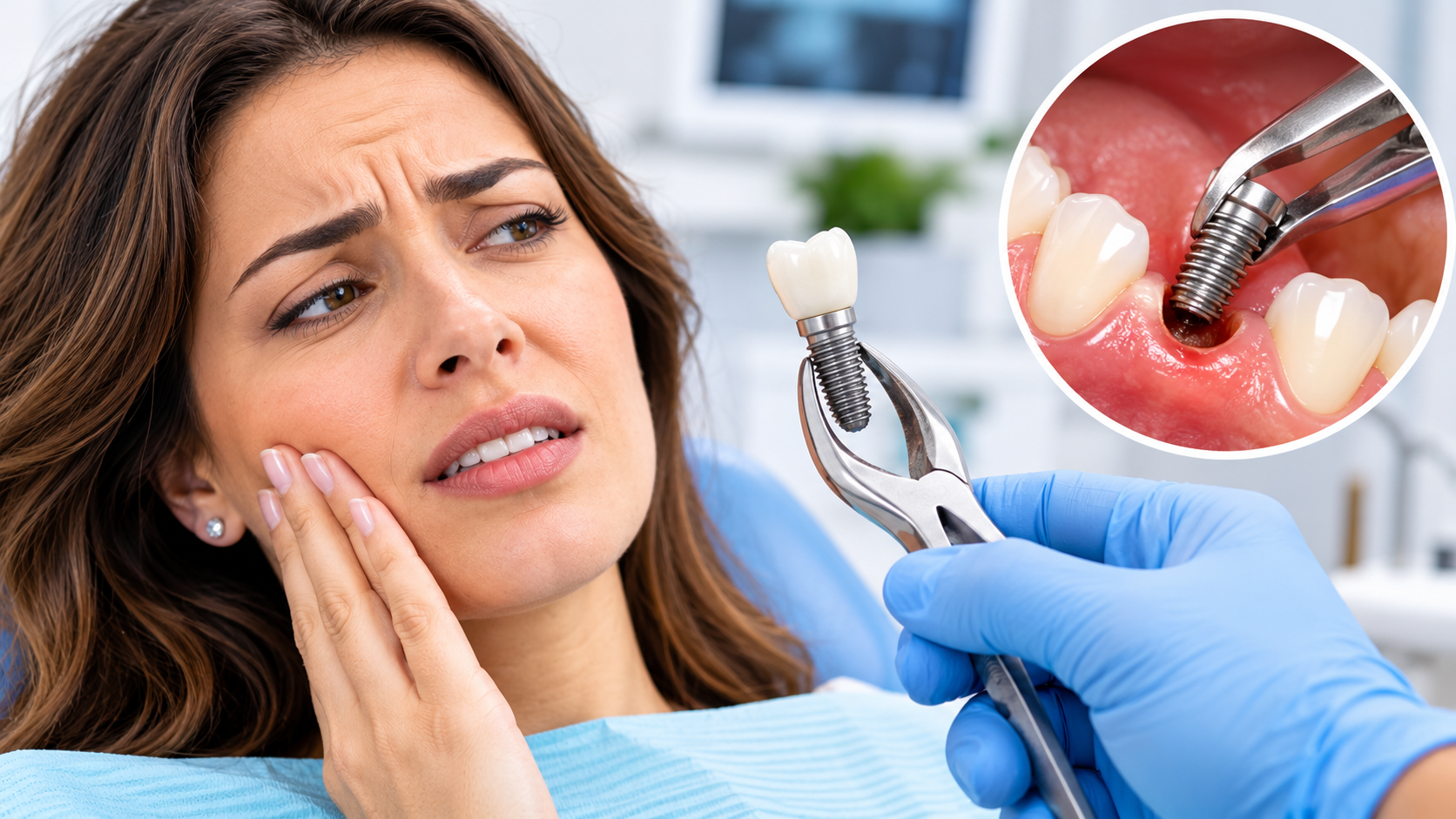

Removing a dental implant is usually not very painful. The area is fully numbed with local anesthesia, and sedation is available for anxious patients, so most people feel pressure during the procedure rather than pain. The soreness comes afterward and is similar to a tooth extraction: tender gums and mild swelling for a few days, usually controlled with over-the-counter pain relievers.
How much you feel depends on the implant. A loose implant that never fused with the bone can come out with very little effort. An implant that has been firmly anchored in the jaw for years takes more work, which can mean a little more soreness during recovery.
At Dental Line, we see patients in Encino who are worried about a sore or loose implant and even more worried about what happens if it has to come out. This article explains why dental implant removal is sometimes necessary, how it is done, and what recovery feels like day by day.
Does Dental Implant Removal Hurt?
Dental implant removal does not hurt during the procedure because the dentist numbs the area completely before starting. You may feel pressure, vibration, or movement, but not sharp pain. If anxiety is a concern, sedation helps you stay relaxed throughout.
Most of the discomfort comes after the anesthesia wears off. Here is what patients typically feel at each stage:
| Stage | What you may feel | How long it lasts |
|---|---|---|
| During removal | Pressure and movement, no sharp pain | The length of the visit |
| First 24 to 48 hours | Soreness, swelling, and some oozing of blood | Peaks in the first two days |
| Days 3 to 7 | Tenderness that fades each day | Usually gone within about a week |
| Weeks 2 to 4 | Gum tissue closing over the site, little or no pain | A few weeks |
| Months 2 to 6 | Bone filling in underneath, no pain | Several months |
Pain that gets worse after the third day, rather than better, is not part of normal healing and should be checked.
Why Would a Dental Implant Need to Be Removed?
A dental implant needs to be removed when it can no longer be saved or when keeping it would damage the surrounding bone. Failed implant removal is uncommon, but these are the usual reasons:
- Peri-implantitis. An infection that destroys the bone around the implant. The American Academy of Periodontology notes that peri-implantitis involves deterioration of the bone supporting the implant and usually requires surgical treatment. When too much bone is lost, removal is often the best option.
- Failed osseointegration. The bone never fused with the implant during healing, so it stays loose.
- A fractured implant. The implant post itself cracks or breaks, which cannot be repaired.
- Poor position or angle. An implant placed too close to a neighboring tooth, a nerve, or the sinus can cause ongoing pain or problems with the crown.
- Nerve irritation. Persistent numbness or tingling after placement can mean the implant is pressing on a nerve.
Most of these problems start with warning signs such as bleeding gums, swelling, or movement. Our article on the biggest complaint about dental implants explains those signs and how to prevent them.
What Makes Implant Removal More or Less Painful?
The difficulty of implant removal, and how sore you feel afterward, depends mostly on how firmly the implant is anchored in bone. These factors make the biggest difference:
- How long the implant has been in place. A recently placed implant that failed to integrate often comes out easily. One that has been fused to the jaw for years needs more work to release.
- Infection and bone loss. Ironically, an implant that has lost a lot of bone to infection is often easier to remove, because less bone is holding it.
- Location. Implants in the dense bone of the lower jaw tend to be held more tightly than implants in the softer bone of the upper jaw.
- Nearby structures. Implants close to a nerve in the lower jaw or the sinus in the upper jaw need more careful planning.
- Implant size. Longer and wider implants have more surface area in contact with bone.
A CBCT 3D scan before the procedure shows exactly where the implant sits in relation to bone, nerves, and the sinus. That planning is what keeps removal gentle and protects as much bone as possible for a future implant.
How Is a Dental Implant Removed?
Dental implant removal is a short outpatient procedure performed under local anesthesia, with sedation available. The steps usually look like this:
- Exam and imaging. The dentist checks the implant, the gums, and the bone with a 3D scan and plans the least invasive way to remove it.
- Numbing and sedation. Local anesthesia numbs the area completely. Sedation can be added if you are nervous.
- Removing the crown and abutment. The visible tooth and the connector piece are taken off first.
- Removing the implant. For many implants, the dentist uses a reverse torque technique, which unscrews the implant counterclockwise with a special tool. If the implant is fused too firmly, a small hollow drill called a trephine bur removes a thin ring of bone around it.
- Cleaning the site. Any infected tissue is removed so the area can heal cleanly.
- Bone grafting, if needed. Graft material may be placed in the socket to preserve bone for a future implant.
- Stitches. The gum is closed over the site, and you receive aftercare instructions.
Because the area is numb, most patients describe the experience as similar to having a tooth pulled.
Dental Implant Removal Recovery: What to Expect
Implant removal recovery is usually quick for the gums and slower for the bone. Most people return to normal routines within a day or two, while the bone underneath keeps healing for several months.
These steps keep you comfortable during the first week:
- Use ice in the first 24 hours. Hold an ice pack on your cheek for 20 minutes on, 20 minutes off to limit swelling.
- Take pain relievers as directed. Ibuprofen or acetaminophen usually controls the soreness. Take any prescribed antibiotics until they are finished.
- Protect the blood clot. Avoid straws, spitting, and smoking for the first few days, since suction and smoke can loosen the clot and slow healing.
- Eat soft foods. Yogurt, eggs, soup, and mashed potatoes are easy choices. Chew on the other side until the site is comfortable.
- Keep the area clean. Brush gently around the site and rinse with warm salt water after the first day, or as your dentist recommends.
- Rest the first evening. Skip heavy exercise for a couple of days to reduce bleeding and throbbing.
Your dentist will usually see you for a follow-up visit to check healing and remove stitches if needed.
When to Call a Dentist After Implant Removal
Call your dentist if pain or swelling increases after the third day, or if you notice any of the following:
- Bleeding that does not slow with gentle pressure
- Fever, pus, or a bad taste that does not go away
- Swelling that spreads toward your eye, jaw, or neck
- Numbness that lasts after the anesthesia should have worn off
- Pain that keeps you from eating or sleeping
These signs can point to infection or a problem with healing. If they happen outside a scheduled visit, Dental Line offers same-day emergency dental care in Encino, including Sunday hours for urgent visits.
Can a Failed Dental Implant Be Replaced?
A failed dental implant can usually be replaced once the site has healed. Most patients wait several months for the bone to fill in, often three to six months, and longer when a bone graft is needed. In some early failures with a clean site, a new implant can be placed sooner.
Bone grafting is often the step that makes a second implant possible. The American Association of Oral and Maxillofacial Surgeons explains that when bone has eroded and weakened, grafting bone to the area can strengthen it for placement of a dental implant.
Before placing a new implant, the dentist should find out why the first one failed. Treating gum disease, adjusting the bite, or changing the implant position keeps the same problem from happening again. When an implant is not the right choice, a bridge or a denture can replace the tooth instead. You can read more about candidacy, bone loss, and recovery in our dental implant FAQ.
Dental Implant Care in Encino at Dental Line
Dental Line provides dental implant treatment in Encino from our office at 18024 Ventura Blvd, with care led by Dr. Irena Starchenko, DDS. If your implant is sore, loose, or infected, including one placed at another office, we can examine it and explain whether it can be saved or needs to come out.
- Advanced CBCT 3D scans to see the implant, bone, nerves, and sinus before any treatment
- Sedation options for patients with dental anxiety, along with local anesthesia
- Premium Swiss Straumann implants when a replacement implant is the right next step
- Same-day appointments in most cases when you call in the morning, and Sunday hours for urgent visits
- Clear pricing, with implants starting at $1,800, flexible financing, and acceptance of most PPO dental insurance plans
Frequently Asked Questions
Is removing a dental implant more painful than getting one?
Usually not. Both procedures are done with local anesthesia, and many patients find removal less involved than the original placement, especially when the implant is already loose. Recovery is often similar to a simple tooth extraction.
How long does dental implant removal take?
Removing a single implant is usually a short visit. A loose implant can come out in minutes, while a firmly fused implant or a case that needs a bone graft takes longer. Your dentist can estimate the time after reviewing your 3D scan.
Will I need a bone graft after implant removal?
Many patients do, especially when infection or removal has left a large gap in the bone. A graft preserves the shape of the jaw and makes a future implant more likely to succeed. Small defects sometimes heal well without one.
Can I go back to work the day after implant removal?
Most people return to work or school the next day. If you had sedation, plan to rest for the remainder of the day and have someone drive you home. Avoid strenuous exercise for a couple of days.
What happens if a failed implant is not removed?
A failing implant with an active infection can keep destroying the bone around it. The longer it stays, the more bone is lost, which makes a replacement implant harder to place. Early evaluation gives you more options.
Can a dental implant fall out on its own?
An implant that never fused with the bone, or one that has lost most of its bone to infection, can become loose enough to move or come out. If your implant feels loose, see a dentist promptly rather than waiting for it to fall out.
Talk to Us About a Painful or Loose Implant
Dental implant removal is rarely as painful as patients fear, and a failed implant is usually a fixable problem. The sooner a dentist evaluates it, the more bone is preserved for a replacement. If an implant is bothering you, schedule an implant evaluation or call (747) 265-6179 to visit our Encino office.