
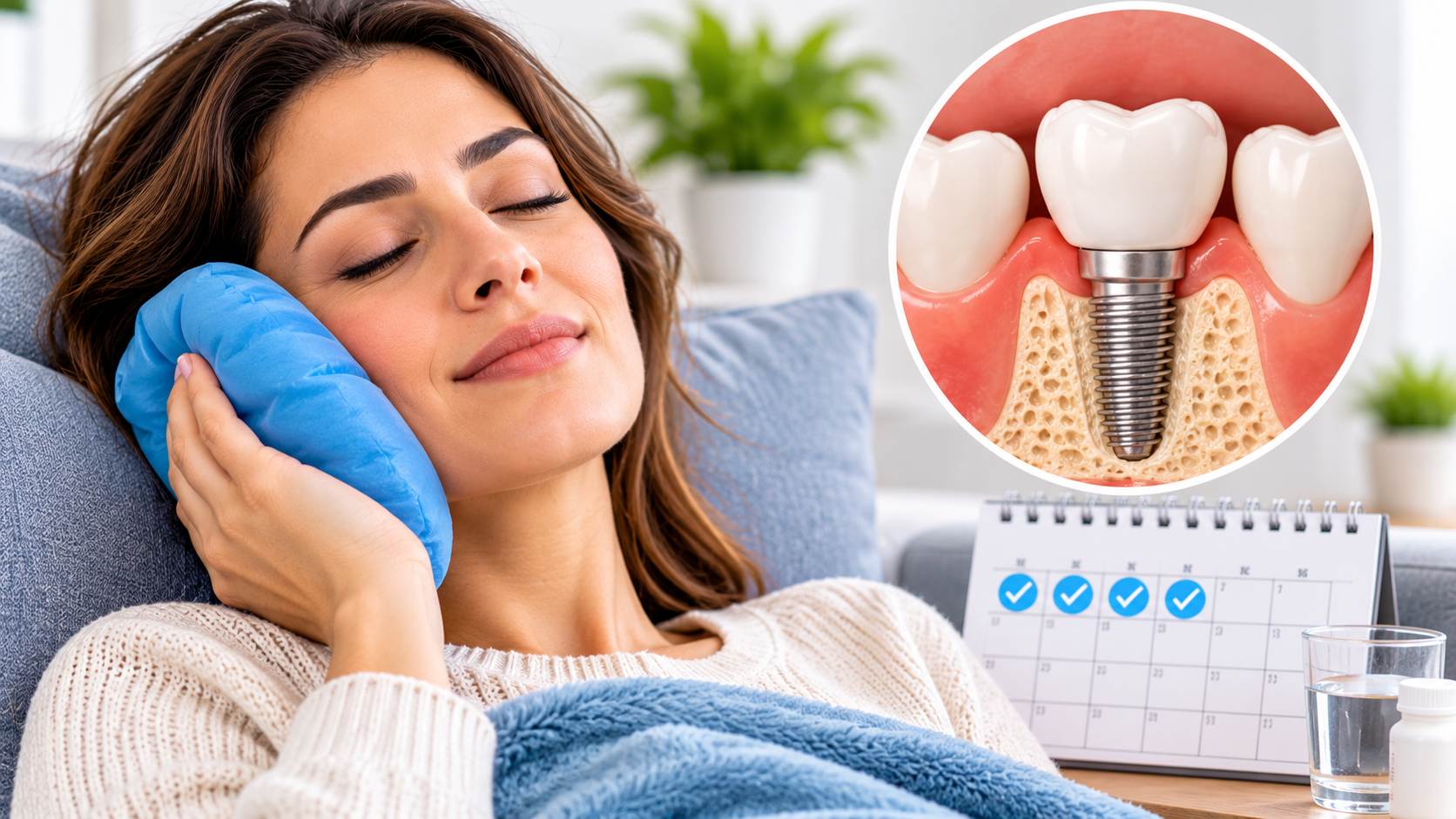

Most people should rest for 2 to 3 days after dental implant surgery. Plan to take the rest of the surgery day off, return to desk work within 1 to 3 days, and wait about a week before strenuous exercise or heavy lifting. Patients who have several implants, a bone graft, or an extraction at the same visit may need a few extra days.
The rest period is short because most of the healing happens quietly over the following months, while the implant fuses with the jawbone. The first few days matter most, since that is when the blood clot forms and the gums begin to close around the implant.
At Dental Line, patients in Encino often ask how much time to block off before scheduling implant surgery. This article lays out a realistic dental implant recovery time, day by day, along with clear guidance on work, exercise, and the signs that you need more rest.
How Much Rest You Need: A Quick Activity Guide
Rest needs after dental implant surgery depend on the activity. The table below shows when most patients return to common activities after a single, straightforward implant.
| Activity | When most patients resume it |
|---|---|
| Rest at home | The day of surgery and the next 1 to 2 days |
| Desk work or school | 1 to 3 days |
| Driving | The next day if you had sedation; the same day with local anesthesia only |
| Gentle walking | 1 to 2 days |
| Light exercise (easy cycling, yoga without inversions) | 3 to 5 days |
| Physical job or heavy lifting | About 1 week |
| Running, weight training, or high-intensity workouts | 1 to 2 weeks |
| Contact sports | After your dentist clears you, with a mouthguard |
| Flying | 2 to 3 days for a single implant; longer after a sinus lift |
| Normal chewing on the implant side | After the gums heal and your dentist approves |
Your dentist may adjust these timelines for more complex procedures, so treat them as a starting point rather than a rule.
Day-by-Day Dental Implant Recovery Timeline
Dental implant recovery follows a predictable pattern. Discomfort peaks early, fades within a week, and gives way to months of healing you will barely notice.
Day of surgery
The area stays numb for several hours after the procedure. If you had sedation, someone needs to drive you home and stay with you for the rest of the day. Rest with your head raised on pillows, use an ice pack on your cheek for 20 minutes on and 20 minutes off, and stick to cool, soft foods once the numbness wears off.
Days 1 to 3
Swelling and soreness usually peak between 48 and 72 hours after surgery, which is why these are the most important days to rest. The American Association of Oral and Maxillofacial Surgeons explains that resting and minimizing activity after implant surgery lets the body focus on healing without putting undue stress on the surgical site. Light oozing of blood is normal in the first day or two.
Days 4 to 7
Swelling goes down and tenderness fades each day. Most patients are back to their normal routine by the end of the first week, apart from strenuous exercise and chewing hard foods on the implant side.
Weeks 2 to 4
The gums close around the implant, and any stitches dissolve or are removed at a follow-up visit. You can gradually add firmer foods, while still avoiding very hard or sticky foods near the implant.
Months 2 to 6
The implant fuses with the jawbone, a process called osseointegration. You will not feel this happening, but it is the reason the final crown is placed only after a healing period of a few months. Our page on dental implants in Encino explains each stage of treatment, from planning to the final crown.
When Can You Go Back to Work After a Dental Implant?
Most people go back to work 1 to 3 days after dental implant surgery. The right timing depends on what your job asks of your body and your mouth:
- Desk jobs and remote work. Many patients return the next day, or after two days if they had sedation or noticeable swelling.
- Jobs with a lot of talking. Teachers, salespeople, and customer-facing staff often prefer 2 to 3 days, because talking for hours can tire a sore jaw.
- Physical jobs. Construction, warehouse work, nursing, and other jobs with lifting or bending usually need about a week, since straining raises blood pressure in the head and can restart bleeding at the site.
Scheduling surgery on a Thursday or Friday gives many patients the weekend to rest without taking extra days off.
When Can You Exercise After a Dental Implant?
Exercise after a dental implant should come back in stages over one to two weeks. Hard exercise raises your heart rate and blood pressure, which can cause throbbing, bleeding, and extra swelling at a fresh surgical site.
- Days 1 to 2: gentle walking only. Short, easy walks help circulation without straining the site.
- Days 3 to 5: light activity. Easy cycling, stretching, or yoga without upside-down poses is usually fine if you feel well.
- About 1 week: moderate exercise. Jogging, swimming, and lighter weights can return if there is no bleeding or throbbing.
- 1 to 2 weeks: full workouts. Heavy lifting, high-intensity training, and long runs can return once your dentist confirms the site is healing well.
If any workout causes throbbing or bleeding, stop, rest for another day or two, and try a lighter routine. For contact sports, ask your dentist when it is safe to return and wear a mouthguard to protect the implant.
What Can Make Recovery Take Longer?
Some patients need more than the typical 2 to 3 days of rest. These factors usually add time:
- Several implants placed at once, which means more surgical sites to heal
- Bone grafting or a sinus lift, which can add several days of rest and a longer healing period
- An extraction on the same day, which leaves a larger wound
- Sedation, which calls for a full day of rest before driving or working
- Smoking or vaping, which slows healing and raises the risk of implant problems
- Uncontrolled diabetes, which can slow tissue healing
If any of these apply to you, ask your dentist for a personal recovery plan before surgery. Our dental implant FAQ covers smoking, diabetes, and bone grafting in more detail.
How to Rest Well After Dental Implant Surgery
Good rest after implant surgery means protecting the site, not lying in bed for a week. These habits make the first few days easier:
- Keep your head raised. Sleep on an extra pillow for the first two nights to limit swelling.
- Use ice, then warmth. Apply ice in the first 24 to 48 hours, then switch to a warm compress if your dentist recommends it.
- Take pain relievers on schedule. Ibuprofen or acetaminophen, taken as your dentist directs, usually keeps soreness under control.
- Eat soft, cool foods. Yogurt, smoothies eaten with a spoon, eggs, soup, and mashed potatoes are easy on the site.
- Skip straws, smoking, and alcohol. Suction, smoke, and alcohol can disturb the blood clot and slow healing.
- Clean gently. Brush the other teeth as usual and rinse with warm salt water after the first day, or as directed.
Our guide to what to avoid after dental implant surgery goes through the foods, drinks, and habits that slow healing.
Signs You Need More Rest or a Call to Your Dentist
Some soreness is normal, but certain signs mean healing is not on track. Call your dentist if you notice:
- Pain or swelling that gets worse after the third day instead of better
- Bleeding that does not slow with gentle pressure from gauze
- A fever, pus, or a bad taste that does not go away
- Numbness that lasts well beyond the day of surgery
- An implant that feels loose or moves
These symptoms are uncommon, and catching them early usually makes them easy to treat.
After the First Week: Care That Protects Your Implant
Once the rest period is over, daily care keeps the implant healthy for the long term. The American Academy of Periodontology notes that brushing and flossing are still necessary to keep an implant clean and plaque-free, and that periodic follow-up visits are needed to monitor the implant, teeth, and gums. Treat your implant like a natural tooth: brush twice a day, clean around it daily, and keep your regular checkups.
Dental Implant Care in Encino at Dental Line
Dental Line places dental implants in Encino from our office at 18024 Ventura Blvd, with care led by Dr. Irena Starchenko, DDS. We plan each implant with advanced CBCT 3D scans and use premium Swiss Straumann implants. Your consultation is the right time to ask how many days to rest for your specific treatment, so you can plan work and workouts around it.
For anxious patients, we offer sedation options along with local anesthesia. If you are considering sedation, our sedation dentistry FAQ explains how it works, how safe it is, and why you will need a driver on surgery day.
Frequently Asked Questions
Can I go back to work the day after dental implant surgery?
Many patients with desk jobs return the next day after a single implant. If you had sedation, several implants, or a bone graft, plan on 2 to 3 days. Physical jobs usually need about a week.
Can I drive myself home after dental implant surgery?
You can drive yourself home if you had local anesthesia only. If you had sedation, you need someone to drive you home and should not drive until the next day.
Is it normal to be more swollen on day three?
Yes. Swelling usually peaks between 48 and 72 hours after surgery and then starts to go down. Swelling or pain that keeps increasing after the third day should be checked by your dentist.
When can I eat normally after a dental implant?
Stick to soft foods for the first several days, then add firmer foods as the gums heal over two to four weeks. Avoid chewing hard or sticky foods directly on the implant until your dentist places the final crown.
Can I fly after dental implant surgery?
Most patients can fly 2 to 3 days after a single implant if they feel well. After a sinus lift or a bone graft in the upper jaw, ask your dentist first, because cabin pressure changes can affect the healing sinus.
How long does it take for a dental implant to fully heal?
The gums heal in a few weeks, while the bone takes a few months to fuse with the implant. The final crown is placed once your dentist confirms the implant is stable.
Plan Your Implant Recovery With Our Encino Team
For most patients, a dental implant means 2 to 3 days of rest, a week of taking it easy, and a few months of healing you will hardly notice. If you are planning implant treatment and want a recovery schedule that fits your work and workouts, book an implant consultation or call (747) 265-6179 to visit our Encino office.